The effective payload of a drone is not just a single number, but a physical boundary collectively determined by its propulsion, structure, and battery. If buyers only look at the nominal maximum payload without questioning the conditions under which this figure is achieved, the actual usable payload upon arrival will highly likely fall short of expectations.
Below, we break down the payload ranges from consumer to industrial grade to clarify the three variables with the greatest impact.
1. Consumer vs. Industrial Grade: The Real Gap in Payload Ranges
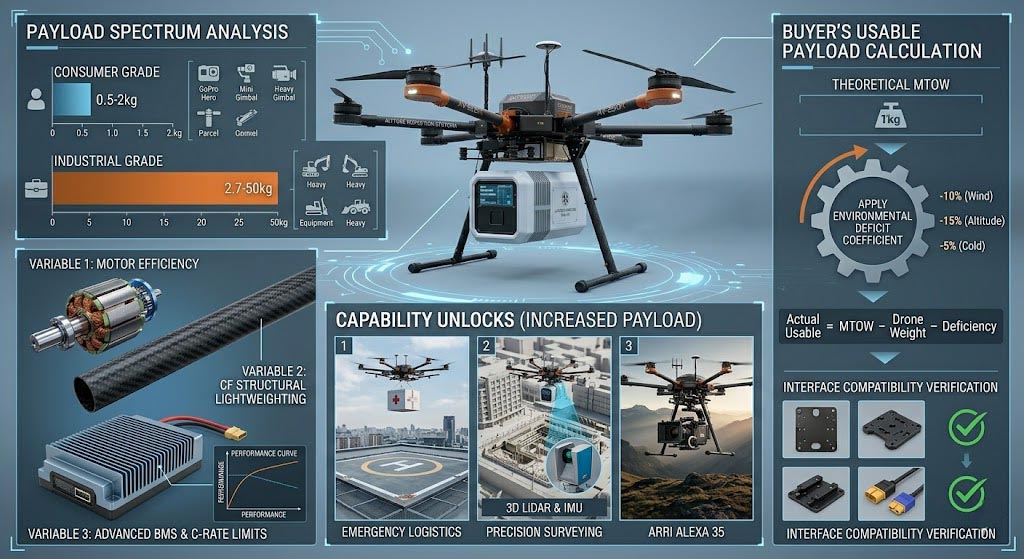
The effective payload of consumer-grade drones is concentrated in the 0.5-2kg range. The structural weight of the aircraft already takes up most of the takeoff weight quota, leaving very limited room for third-party payloads—usually only allowing for small gimbal cameras or lightweight sensor modules.
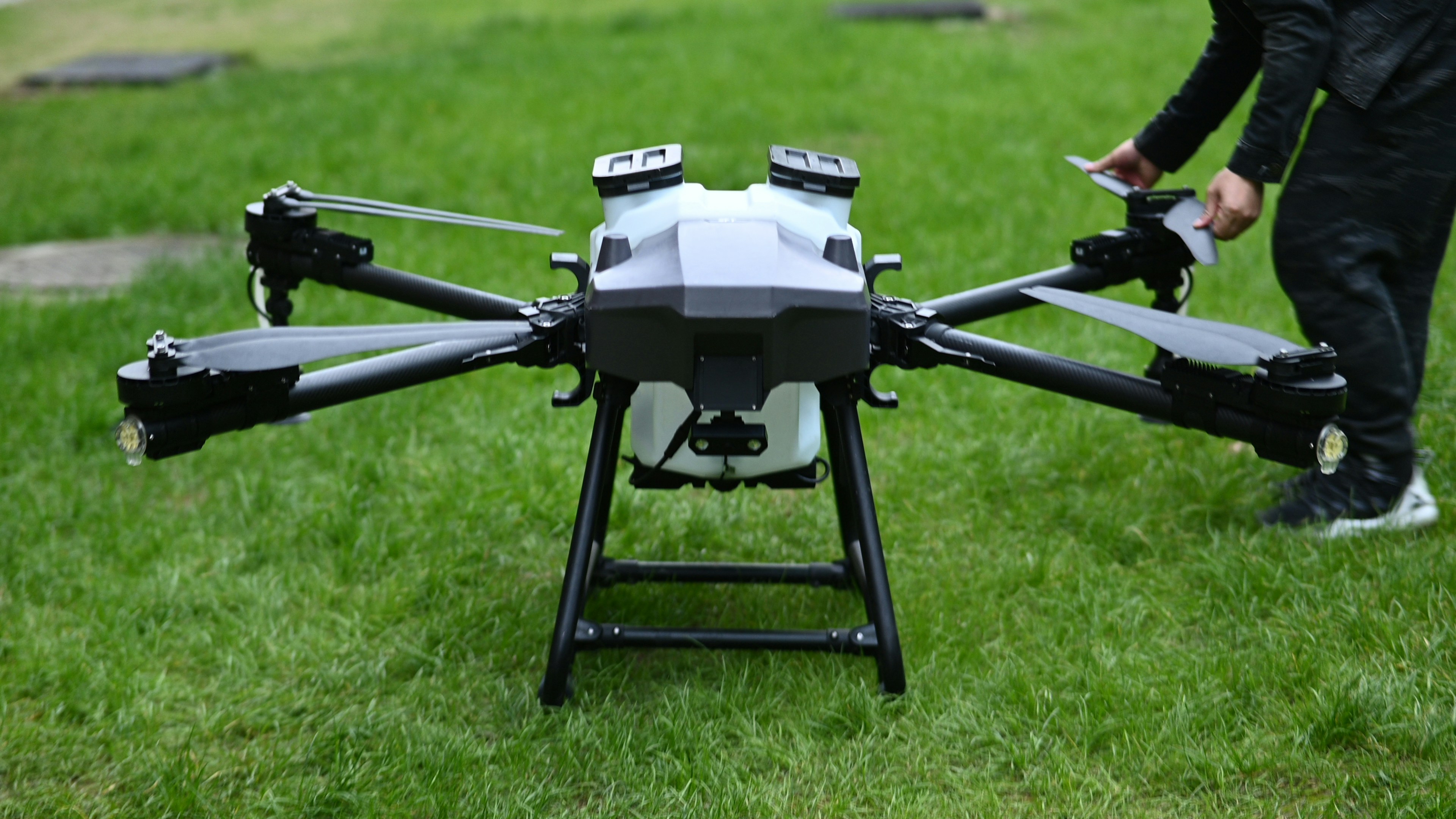
Industrial-grade drones enter an entirely different order of magnitude. The DJI Matrice 350 RTK has a maximum takeoff weight of about 9.2kg. Deducting the aircraft's own weight, the effective payload is around 2.7kg, which can carry mission equipment such as LiDAR, dual-light gimbals, or multispectral cameras. Moving further up, the payload of logistics platforms like the DJI FlyCart 30 jumps directly to the 30kg tier, capable of completing mountain material deliveries in a single flight. For the agricultural line, the DJI Agras T50 has a spray payload of about 40kg (spraying) / 50kg (spreading), offering a per-flight coverage efficiency that is completely on a different level compared to consumer drones.
Cross-grade selection means the simultaneous upgrade of propulsion platforms, compliance thresholds, and accessory ecosystems—it is not as simple as just buying a larger airframe.
2. Three Underlying Variables Affecting Payload
1. Propulsion System: Motor Count Does Not Scale Linearly
Motor power directly determines the upper limit of lift. Multi-rotors increase total thrust by adding more motors, but the efficiency does not scale linearly. Compared to a quadcopter, a hexacopter increases payload capacity by about 40%, but the power consumption increases at a higher ratio, which simultaneously compresses the actual flight time. The extra rotor redundancy not only increases payload but, more critically, provides a controllable emergency landing capability if a single motor fails.
2. Structural Design: Weight Reduction = Indirectly Increasing Payload
A carbon fiber body reduces weight by about 30% compared to engineering plastics under the same strength. This means that for every 1kg saved in structural weight, an additional 1kg of mission payload can be carried. The DJI Matrice series utilizes carbon fiber arms and magnesium alloy body frames, which is essentially fine-tuned engineering balancing material cost, structural strength, and aircraft weight.
The impact of foldable designs on payload is often overlooked. The added structural weight and potential clearance of folding joints convert into micro-attitude disturbances under full-load vibration conditions, forcing the flight controller to consume extra power for compensation.
3. Battery Technology: Energy Density Determines the Operational Window
Lithium batteries are currently the mainstream solution for industrial drones. Every increase in energy density extends the usable flight time under the same weight. If solid-state batteries achieve mass production and commercialization, flight times are expected to increase by 50%, directly expanding the working duration of the effective payload.
For DJI platform users, the batteries utilize a Battery Management System (BMS). Third-party payloads must verify their power supply method—the flight controller's PSDK power port has limited wattage, and high-power payloads require an independent power supply module to prevent triggering voltage protection.
3. New Scenarios Driven by Payload
The improvement of payload capacity has unlocked practical applications in the following directions:
Emergency Rescue: A fire-extinguishing bomb payload weighs about 3kg. Paired with an airborne precision dropping system, it can execute pinpoint deliveries at high-rise buildings or at the ignition points during the early stages of a wildfire. The ground station of the DJI FlyCart 30 supports pre-programmed flight path dropping, allowing automated execution even at night or when visibility is obstructed.
Logistics Transportation: In mountain delivery scenarios with a single-flight payload of 15-30kg, the terrain-following capability of the flight path is more prone to issues than the payload weight itself—GPS signal drift while traversing canyons can cause flight path deviations.
Agricultural Plant Protection: Heavy-duty plant protection models (such as the DJI Agras series) can achieve a spraying efficiency of hundreds of acres per flight, but actual efficiency highly depends on plot shapes and obstacle density. When third-party plant protection payloads are mounted on non-Agras platforms, the communication compatibility between the flow controller and the flight controller is the first hurdle.
Cinematography: Mounting cinema-grade cameras on industrial drones requires the gimbal to have sufficient torque redundancy. The combined weight of the camera and lens is often underestimated—an entry-level cinema camera set with a zoom lens easily exceeds 3kg.
4. Returning to Selection: How to Read the Payload Numbers
Do not just look at a single maximum value for payload parameters. The following three aspects must align simultaneously:
Maximum Takeoff Weight - Empty Aircraft Weight = Theoretical Usable Payload. However, this is laboratory data under room temperature, low altitude, and windless conditions.
Actual Usable Payload = Theoretical Value × Environmental Deficit Coefficient. For high altitudes, it is recommended to calculate at 80%, and low-temperature environments require a further discount.
Third-Party Payload Compatibility. DJI industrial drones open up power supply and data links through PSDK / SkyPort V2 interfaces, but the maximum PSDK power supply limits differ across models—the external power supply wattage of the Matrice 350 RTK is not identical to that of the Matrice 30, requiring a item-by-item verification during selection.
Payload is not that maximum value printed on a brochure; it is the usable number filtered out by your operating environment and mission profile. First clarify the total mission weight (equipment + mount + cables + safety margin), then apply environmental deficits based on actual operating conditions, and finally check interface compatibility and power supply upper limits—once this sequence is completed, your selection can be considered grounded.